
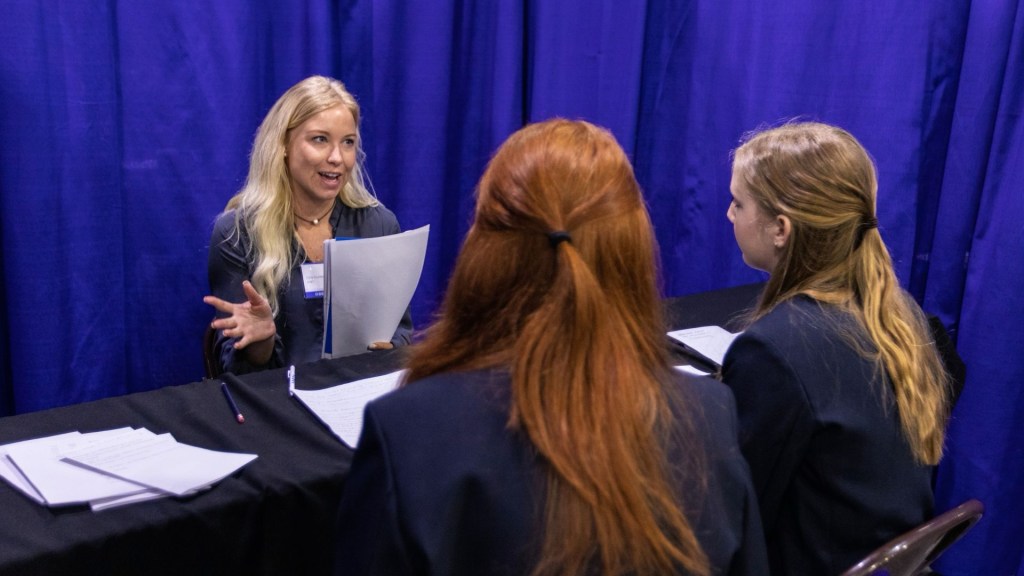
Ten minutes. That’s all you get. When the event coordinator hands you a role play prompt, you have to somehow read it, understand it, plan an entire business solution, and get ready to convince a judge you’re the future CEO of Starbucks. No pressure, right?
Here’s the thing: ten minutes is enough—if you know how to use them. Over the past couple years, I’ve built a system that works for me every single time. It’s structured enough to keep me calm but flexible enough to work for any event. So here’s exactly how I build a role play from scratch in ten minutes, step by step.
Step 1: The Intro (Minute 0–1)
This is where you set the tone. I start by prepping my intro line word-for-word so I don’t freeze the second I sit down. Mine usually sounds like this:
“Hi, my name is Bella Rose, and I’m excited to meet with you today. As your [insert role from the prompt], I’ve reviewed the situation and developed a plan to address it.”
Simple, clear, confident. The handshake, smile, and name exchange might seem small, but trust me—it makes a huge difference. Judges remember competitors who come in looking like they belong in the room.
Step 2: Introduce the Problem (Minute 1–2)
After the intro, I jump straight into showing I understand the problem. I take the scenario, rewrite it in my own words, and deliver it back to the judge. Example:
“We’re facing a decline in customer satisfaction scores due to long wait times at checkout. If we don’t solve this, it could decrease repeat visits and lower overall revenue.”
This proves two things:
1. I read the prompt carefully.
2. I can clearly define the challenge—something a real manager would do before suggesting solutions.
I then add a transition line: “To address this issue, I’ve created a plan with three main solutions that align directly with your goals.”
Step 3: Use the Performance Indicators (Minute 2–4)
This is where the rookie mistake is to skip straight to the solutions. But the judge is literally holding a rubric with these phrases on it, so I tackle them head-on. Example set of five PIs (yours will change per event, but this is the structure):
1. Explain the nature of effective customer service.
“Customer service is about creating consistent, positive experiences that drive loyalty. For us, that means shorter wait times and friendly staff interaction. If we don’t fix those, promotions alone won’t keep customers coming back.”
2. Describe factors affecting business risk.
“One risk we face is investing in promotions that don’t generate enough return. Another is staff resistance to new processes. By keeping costs low and adding training, we can minimize those risks.”
3. Demonstrate knowledge of promotional methods.
“Promotions can be in-store, digital, or community-based. I recommend focusing on loyalty rewards and social media engagement since they directly reach repeat customers at low cost.”
4. Explain the use of financial data.
“Financial data lets us measure whether a plan is successful. For this situation, we’ll track daily sales, average order value, and cost of promotion to calculate ROI.”
5. Discuss the role of ethics in business.
“Ethical practices build trust. We’ll make sure promotions are transparent—no hidden fees—and that staff training focuses on respectful customer interactions.”
By the time I’ve hit all five, I’ve already shown the judge I know my basics. Then I pivot: “Now that I’ve explained these key business factors, here are the three concrete solutions I propose.”
Step 4: Build the Solutions (Minute 4–7)
Here’s where the role play really comes alive. Instead of just listing solutions, I show them. Judges see a hundred competitors rattle off “three strategies”—but when you put it into a visual, it clicks.
First thing I do: walk through my plan with a simple, creative model. For example:
- Timeline: “Week 1 we launch the loyalty program, Week 2 we start digital ads, Week 3 we evaluate the results and adjust.” I’ll sketch this out as a three-step flow so the judge can picture the rollout.
- Roadmap: “Think of it in three lanes—customer experience, staff efficiency, and measurable data. Together, these lanes drive us toward our goal of higher customer satisfaction.”
- Pyramid: I’ll stack my three solutions as a pyramid: bottom layer = customer service, middle = promotion, top = metrics. Then I explain how they build on each other.
This gives the judge a mental image and makes me look polished and organized.
If there’s still time left: I layer on a framework. My go-to choices are:
- SWOT (strengths, weaknesses, opportunities, threats) → makes me sound strategic.
- Pros/Cons table → shows I’ve considered alternatives and risks.
- SWORD Plan (situation, weakness, opportunity, recommendation, data) → neat storytelling arc.
I don’t always get to both, but even one visual model sets me apart from competitors who just talk in circles.
Step 5: Takeaways (Minute 7–8)
At this point, I give the judge the “so what.” I want them to remember the big picture. Something like:
“These solutions will not only solve the immediate issue of long wait times but also improve customer satisfaction and increase revenue long-term. The plan is realistic, affordable, and measurable—three things we need for sustainable success.”
Think of this section as the headline you’d want on a news article: short, sharp, memorable.
Step 6: The Q&A (Minute 8–9)
This part can be nerve-wracking, but I actually love it because it gives me a chance to show I can think on my feet. Judges will ask questions, and the rookie mistake is to panic when you don’t know the “perfect” answer.
My strategy? Redirect and connect back to the solutions. For example:
- Judge: “What if the loyalty program is too expensive to run?”
- Me: “That’s a great point. The good news is, the cost is minimal—primarily in printing and digital promotion—and the increased repeat purchases will quickly offset it. If budget still becomes a concern, we could shorten the promo window or bundle it with existing ads.”
Even if I don’t have the exact answer, I stay calm, acknowledge the concern, and pivot back to the value of my plan.
Step 7: The Close (Minute 9–10)
Finally, I finish strong. My last line is always polished and confident:
“With your approval, I’ll begin implementing these strategies immediately. By reducing wait times, launching our loyalty program, and tracking results, we’ll see improved customer satisfaction and stronger revenue by the end of this quarter.”
Then: handshake, smile, exit. That last impression matters just as much as the first.
Final Word
Role plays aren’t about having the fanciest vocabulary or the most complicated business plan. They’re about structure, clarity, and confidence. By introducing yourself well, describing the problem, highlighting the PIs, presenting three solid solutions, summarizing your takeaways, and handling Q&A with composure, you can turn ten minutes of prep into ten minutes that win over a judge.
Trust me—you don’t need perfection. You just need a process.









Leave a Reply