
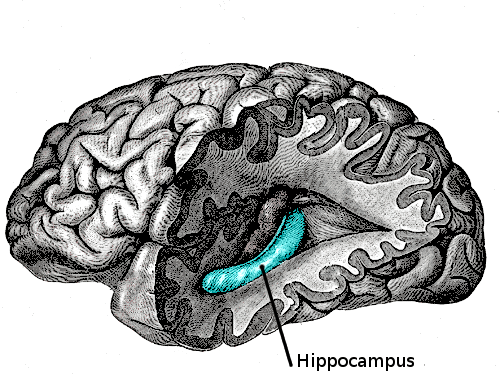
Let’s play a game: where were you when you found out Taylor Swift dropped Folklore? Or what did you eat for breakfast yesterday? Chances are, if you answered either of those, you just used a seahorse-shaped brain structure called the hippocampus.
Yes, seahorse-shaped. The name literally comes from the Greek words hippos (horse) and kampos (sea monster). Neuroscientists apparently thought “seahorse brain blob” was too informal, so we got “hippocampus” instead.
So why does this little sea creature tucked inside your temporal lobe matter so much? Because it’s basically your memory hard drive.
Meet Your Brain’s Filing System
The hippocampus sits in the medial temporal lobe, one on each side of your brain. Picture it as the librarian of your mind: it doesn’t store all your memories forever, but it decides where they go and helps you retrieve them when needed.
Here’s the breakdown:
- Encoding: Turning new experiences into storable data. (That random fact you learned in AP Psych? Thank the hippocampus for filing it away.)
- Consolidation: Moving short-term memories into long-term storage. Like hitting “Save” on a Word doc instead of leaving it in “Unsaved Drafts.”
- Retrieval: Pulling up info when you need it. Without a hippocampus, “What’s on the exam?” would be a terrifying blank.
Without this system, your life would feel like an endless dream where nothing sticks.
Case Study Throwback: Patient H.M.
No hippocampus spotlight is complete without the most famous neuroscience case study: Henry Molaison (aka Patient H.M.).
In the 1950s, Henry had severe epilepsy, so doctors removed large parts of his medial temporal lobes—including most of his hippocampi. The seizures improved, but he was left unable to form new memories. He could remember his childhood, but if you met him and left the room, he’d forget you were ever there.
H.M. taught scientists two major things:
1. The hippocampus is crucial for making new memories.
2. Not all memory is the same—his ability to learn motor skills (like tracing a shape in a mirror) remained intact, showing that procedural memory lives elsewhere in the brain.
Basically, without hippocampi, you’re living in a mental Groundhog Day.
A Quick History Detour
For centuries, people thought memories were stored everywhere in the brain, like a big soup of neurons. The idea of a specific structure being key didn’t click until the 20th century.
H.M.’s case cracked open the field, but follow-up studies confirmed it. Neuroscientists noticed patients with hippocampal damage struggled to form new memories but could still play piano pieces learned years earlier. That’s how we learned memory isn’t one big “box”—it’s more like a filing cabinet with different drawers: episodic, semantic, procedural.
The hippocampus handles the episodic drawer—your life’s highlight reel.
Why You Should Care (Besides Passing AP Psych)
So what does the hippocampus mean for you? Turns out, a lot.
- Learning: Every flashcard review, every DECA term you memorize, every calculus formula you drill—the hippocampus is the MVP organizing those memories.
- Spatial navigation: It also helps you remember places. Ever wonder how you can walk into your school on autopilot? Hippocampal circuits are guiding you. (Fun fact: London taxi drivers with “The Knowledge” have larger hippocampi than average.)
- Emotional memory: The hippocampus works closely with the amygdala, which explains why some memories are tied so strongly to feelings. You might forget what you ate last Tuesday but vividly remember the embarrassment of tripping in the cafeteria.
And here’s the kicker: your hippocampus is also behind context. It’s why you remember material better when you study in the same place you’ll be tested. Yes, “exam conditions” are literally wired into your memory network.
When the Hard Drive Crashes
Unfortunately, the hippocampus is fragile. It’s one of the first regions hit in Alzheimer’s disease, which is why memory loss is such an early symptom. Traumatic brain injuries and prolonged stress can also shrink hippocampal volume.
And speaking of stress: high cortisol (the stress hormone) isn’t just bad for vibes—it can actually damage hippocampal neurons over time. Translation: endless cramming + zero sleep + caffeine overload = not your hippocampus’s best friend.
But here’s the good news: it’s also one of the most plastic brain regions. Neurogenesis (growth of new neurons) happens here, even in adulthood. Which means you can nurture it.
Hippocampus Care 101
So how do you keep your memory hard drive healthy? Here are science-backed tips:
- Get enough sleep: Memory consolidation literally happens while you snooze. Skipping sleep = skipping the “Save” button.
- Exercise: Aerobic workouts increase blood flow and BDNF, a protein that supports hippocampal growth. (Yes, cross country actually makes you smarter. Kind of.)
- Reduce stress: Easier said than done, but mindfulness, breaks, or just laughing with friends keep cortisol from wrecking the place.
- Learn new things: Challenge your brain with languages, instruments, or even new routes to school. New learning = new hippocampal growth.
- Nutrition matters: Diets rich in omega-3s (salmon, walnuts, flaxseeds) and antioxidants support brain health.
Basically, treat your hippocampus like it’s your GPA: ignore it, and you’ll regret it later.
A Fun Twist: Time Travel
One of the coolest discoveries about the hippocampus? It’s not just for remembering the past—it also helps us imagine the future.
When you picture yourself at college next year, or running your first marathon, your hippocampus lights up. It uses pieces of past experiences to build mental simulations of what could happen. So in a way, it’s your brain’s time machine.
That’s why people with hippocampal damage struggle not only with memory, but also with imagining what tomorrow might look like. Without a functioning hard drive, you lose access to both directions of mental time travel.
Why I’m Kind of Obsessed
The hippocampus is one of those brain structures that makes neuroscience feel real. Like, you can study “neural circuits” all day, but the hippocampus is where science and daily life collide. It explains why you can still recite the Pledge of Allegiance years later, why you know exactly where your childhood best friend’s house is, and why some memories feel stitched into your identity.
It’s also a reminder that our memories aren’t perfect recordings—they’re reconstructed, emotional, and sometimes biased. The hippocampus is a hard drive, yes, but not a flawless one.
Still, without it, life would slip through our fingers moment by moment. And personally, I’d rather remember the embarrassing cafeteria trip than not remember anything at all.






 Mind & Medicine
Leave a comment