
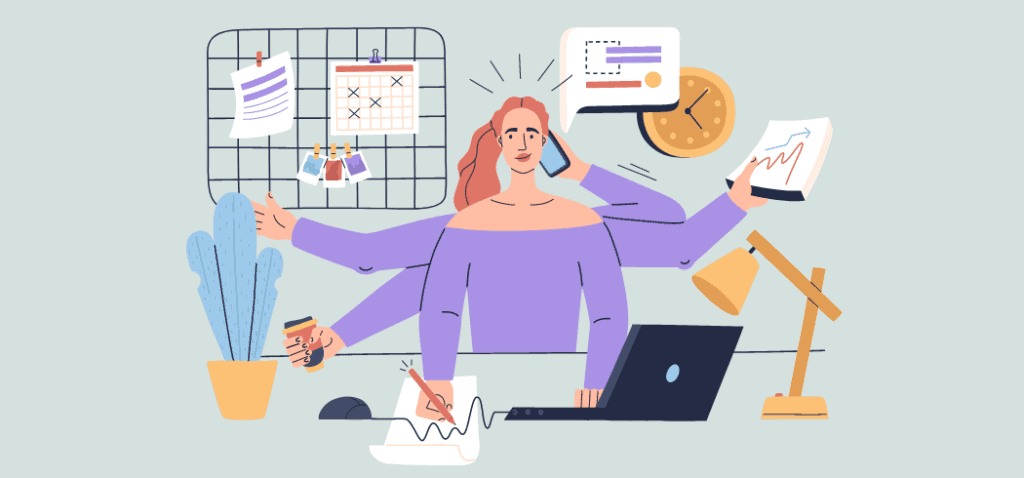
Let’s be honest: multitasking feels like a superpower. Who doesn’t want to be the person typing an essay, texting three group chats, binge-watching Grey’s Anatomy, and somehow still “listening” to their mom all at once? We brag about it—like being busy in four directions at the same time is the flex of the decade.
But here’s the reality check: your brain is not built for multitasking. At least, not the way you think it is.
The Myth of Multitasking
We like to imagine our brains as high-powered laptops, juggling apps with ease. Spotify + Quizlet + Google Docs = no problem. But here’s the thing: your brain isn’t a MacBook Pro. It’s closer to that one Chromebook the school handed you freshman year—works fine, but open too many tabs and the whole thing starts glitching.
What we call “multitasking” is really just task switching. And task switching is like opening and closing apps over and over. It looks busy, it feels busy, but it’s not efficient.
What’s Actually Happening in Your Brain
When you switch tasks, the command center of your brain—the prefrontal cortex (basically your CEO)—has to shut down one set of instructions and load up another.
So let’s say you’re writing your APUSH essay and decide to check Snapchat. Your prefrontal cortex goes:
- Pause the essay rules.
- Open the Snapchat rules.
- Go back to the essay and… wait, where was I again?
Every switch comes with a cost. Studies show productivity can drop by up to 40% when you multitask. That’s almost like throwing away half your study session. And you know that weird brain fog when you look up after scrolling TikTok mid-homework and can’t remember what you were doing? That’s the switching cost in real time.
But What About Walking and Talking?
Okay, valid question. If multitasking is fake, how can we walk and talk at the same time? Or sing along to music while driving?
That works because those tasks live in different brain systems. Walking is automatic—it runs on lower brain structures like the cerebellum. Talking, meanwhile, needs higher-level circuits. When tasks don’t compete for the same brain “department,” you can do them together.
The problem is when you try to double up on tasks that both need your prefrontal cortex. Reading a textbook while texting? Both demand language and attention. One of them is going to lose. (Spoiler: it’s always the textbook.)
The Illusion of Productivity
Here’s why multitasking is so tempting: it feels productive. Each time you switch tasks, your brain gets a tiny dopamine hit—new message! new TikTok! new email!—and dopamine makes you feel like you’re winning.
But in reality, you’re just scattering your focus into tiny fragments. Ever reread the same paragraph five times and still not know what it said? That’s your hippocampus refusing to properly file memories while you’re too busy hopping between tabs.
A Quick Research Reality Check
In 2009, Stanford ran one of the first big multitasking studies. Psychologist Clifford Nass tested “heavy multitaskers”—the people who swore they were amazing at juggling everything. The result? They were actually worse at filtering out distractions, slower at switching tasks, and more error-prone overall.
In other words, the “multitasking champs” weren’t superhumans. They were just… distracted.
Brain scans back this up. fMRI studies show the prefrontal cortex doesn’t split into two and handle both tasks. It lights up in one spot, then flips to another, then back again. Imagine trying to watch two Netflix shows by constantly switching the remote every 10 seconds. That’s multitasking.
The Student Angle
Here’s where this hits hardest: school. We’re constantly told to do more in less time, which usually = multitask your way through homework. But science says it’s a scam.
- Study sessions with your phone nearby = weaker memory encoding. Your hippocampus can’t lock in vocab if it’s also pinging every time you get a DM.
- Music with lyrics while reading? Your brain is fighting itself for language resources. (Instrumental > Olivia Rodrigo when it’s crunch time.)
- Notifications on = your IQ drops as much as if you pulled an all-nighter. Yep. Just existing with pings around you makes you dumber.
So when you wonder why that three-hour “study session” didn’t stick, it’s probably because you weren’t actually studying—you were just switching.
The Real-World Stakes
And this isn’t just about teenagers procrastinating on math homework. Adults fall for the same trap. Texting while driving slows reaction times as much as alcohol. Nurses who multitask charting make more errors. Pilots distracted mid-flight? Disastrous.
When focus is split, mistakes multiply.
How to Outsmart Your Brain
The good news: you don’t need to become a monk to beat multitasking. You just need to lean into single-tasking, the thing your brain is actually built for.
- Batch your tasks: Reply to all texts at once, then move on. Don’t weave them into your homework.
- Try time blocks: Even 25 minutes of pure focus (Pomodoro style) beats 90 minutes of multitasking chaos.
- Silence the noise: Phones in other rooms = instant GPA boost. Don’t just silence notifications—hide the source.
- Switch smart, not often: Finish one chunk of an assignment before jumping to the next. Clean handoff > messy juggling.
Think relay race, not circus act.
The Few Exceptions
There are some multitask “green lights.” Pairing an automatic task with a conscious one can work. Folding laundry while listening to a podcast? Sure. Running while thinking through a DECA roleplay? Perfect.
But even then, only one thing is getting your active brain power. The other is on autopilot.
The Future Problem
Here’s the kicker: our world is literally designed to make us multitask. Notifications, ads, constant pings—it’s all training your brain to chase novelty instead of focus. Even AI assistants risk pulling you into more tab-switching if you’re not careful.
Which means learning to single-task isn’t just about productivity—it’s about survival in a distraction economy.
Why I Weirdly Like This
I used to take pride in being a multitasker. Ten tabs open, Spotify blasting, essay halfway done—it felt like proof I was working hard. But finding out multitasking is basically a myth? Weirdly freeing.
Because it’s not me being “bad at focusing.” It’s my brain doing what brains do. And instead of fighting it, I can just work with it. One task, one lane, less chaos.
Honestly, in a world that worships busyness, single-tasking feels like rebellion. The real flex isn’t doing everything at once—it’s doing one thing well.







 Mind & Medicine
Leave a comment