
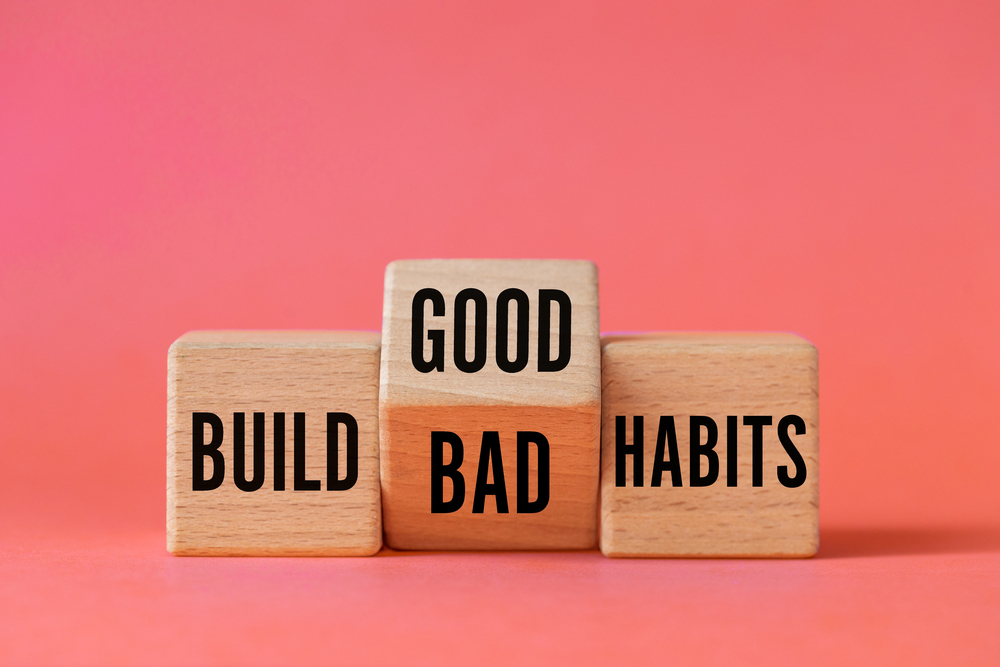
If you’re a high schooler or middle schooler who just went back to school, how many times have you reached into your backpack for your phone before remembering it’s against the rules? Or been in the shower wondering, “Wait… did I already wash my body?” Or stood in the kitchen unsure if you’ve already taken your vitamins?
That’s because these actions are habits—built into your daily routine so deeply that you barely have to think about them.
Think about brushing your teeth. You don’t narrate it step-by-step (“grab the toothbrush, grab the toothpaste, apply the toothpaste…”). You’re probably thinking about your day or something completely different. That’s what habits do: they run in the background so your brain doesn’t have to waste energy.
Some habits are good for you (brushing your teeth, showering, taking vitamins). Others… not so much (scrolling TikTok at midnight, eating junk food). The tricky part? Even when you know a habit is bad, it can still feel easier than doing the healthy thing.
Why Habits Feel Automatic
Your brain loves shortcuts. Every time you repeat something—scrolling at night, tying your shoes, grabbing coffee before class—it shifts from “thinking mode” into autopilot. Research shows nearly 40% of what we do daily is pure habit, not conscious choice.
That’s why habits feel so natural: your brain literally outsources them to its autopilot system.
The Habit Loop: Cue → Routine → Reward
Every habit runs on the same loop:
- Cue: The trigger that signals your brain. You see your phone light up.
- Routine: The action (behavior/feeling) that follows the cue. You check it automatically.
- Reward: The positive feeling or relief you get afterward. You get a dopamine hit from a text or notification.
Dopamine is the chemical that makes you feel good, and it’s what keeps the loop alive. But here’s the twist: you don’t just get dopamine from the reward—you also get it from expecting the reward. That’s why even hearing someone else’s phone buzz can make you crave checking yours.
Neuroplasticity: Your Brain’s Rewiring Tool
Your brain isn’t fixed. Every time you repeat a habit—good or bad—you’re training neurons to wire more tightly together. Scientists call this neuroplasticity: your brain’s built-in ability to rewire itself.
“Neurons that fire together, wire together.” That’s the easiest way to remember it. The more you repeat something, the stronger the pathway becomes. Stop walking down that “path,” and it gets overgrown. Start walking a new one, and it becomes easier to follow.
The Brain Regions Behind Habits
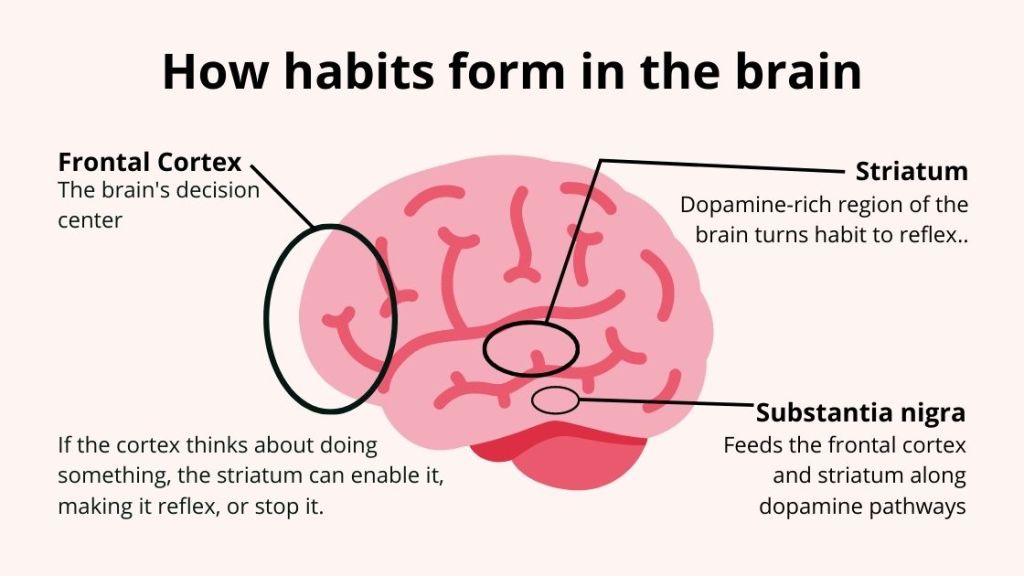
Habits aren’t just about willpower. They’re about brain wiring:
- Striatum – the habit hub. It decides which routines are worth locking in. Within it, the dorsolateral striatum handles rigid, automatic habits, while the dorsomedial striatum handles flexible, goal-directed ones.
- Frontal cortex – the boss at the beginning. It sets intentions and makes decisions early on, but as habits solidify, control shifts to the striatum. Think of it like a manager training employees, then stepping back once they’ve got the routine down.
- Substantia nigra – the dopamine powerhouse. It fuels the cue-routine-reward loop by releasing dopamine into the striatum.
Why Breaking Habits Feel Impossible
Here’s the tough part: once a habit is wired into the striatum, it never really disappears. The circuits can go quiet, but they’re always there, ready to fire again. That’s why relapse happens—whether it’s with social media or something as serious as addiction.
And dopamine makes it worse. Bad habits usually come with instant rewards (a sugar rush, a notification), while good habits take longer to pay off (like exercising). Your brain naturally gravitates to what feels good right now.
To top it off, cues are sneaky. A couch can trigger snacking. Nighttime can trigger scrolling. Your brain doesn’t just remember the routine—it remembers the context.
How to Outsmart Your Brain
So if you can’t erase habits, what can you do? Outsmart them.
- Don’t erase, replace. Swap the routine, not the cue. If stress (cue) makes you want to scroll (old routine), try taking a walk instead (new routine). The first few times will feel impossible. But repetition rewires the loop.
- Change the cue. Instead of battling your phone at night, move it out of your room. No cue = no loop.
- Shrink the habit. Make bad habits harder and good ones easier. Hide snacks. Put your phone across the room. But keep water on your desk, sneakers by the door, or your journal on your pillow.
- Stack habits. Link a new habit to an old one. After brushing your teeth → journal for 5 minutes. After starting the coffee pot → drink one glass of water. Soon, your brain stores them as a single sequence.
Habits aren’t just quirks of self-control—they’re your brain’s way of conserving energy. That’s why they feel automatic, and why they’re so stubborn. But because of neuroplasticity, your brain can rewire. It’s not about fighting old habits into extinction—it’s about outsmarting them, step by step, until the new path feels just as automatic.






 Mind & Medicine
Leave a comment